Sunday, March 20, 2022

03-20-22 “Reaching up to hold Daddy’s hand”

Scripture   Mark 5:21-43

          Have you ever felt physically, mentally, emotionally, spiritually, economically, or relationally tired or exhausted? Have you ever been in the midst of a rough time and you just need a break, you can’t hardly stand it any more? Have you ever felt at the end of your rope, like you just can’t hang on any longer? Or like you are on a bike racing downhill and you forgot how to break? (Me at Put-in-Bay on a bike) Have you ever been in a situation where you need someone to tell you “It will be alright.”? Have you ever gotten 18” of string but a lot more would have made things better?
          By example, On his way to the cross, Jesus shows us how to find strength, comfort and peace in the midst of tough situations, and then by who he is, he shows us how he wants to give us more than a small piece of string.
 
          Let’s look at his example as he is about to face the toughest moments of his life on earth. Remember that besides being God, he is also fully human and feels the same physical and emotional kinds of pain that we suffer from. Not only was he facing, being spat upon, ridiculed, having thorns crushed in his head, sleep deprivation, having his back whipped to shreds, having to carry his own cross and then be nailed to that cross and crucified, he was also facing his 3 closest friends and partners in ministry sleeping when he begged them to stay awake to pray with him, one disciple who would betray him to the Roman authorities, his strongest disciple who would deny evening know him, not once but 3 times, his band of followers would disband so they would not be associated with him as he was on trial and facing death. During his last teachable moments it still seemed like his disciples were not understanding what he was teaching them and he was about to leave his movement, his kingdom, his church in their hands.
 
          You can look in books and on the internet and even in the bible to see what Jesus did during his last week, when he had the advantage of knowing he was facing the cross. When my mom knew she was dying, she got to tie up loose ends and say goodbye to everyone. Jesus has a week to make sure the disciples are ready to take charge and change the world. So go ahead and find one of those charts people have made of his last week and see what Jesus was doing on his very last Sabbath (Saturday) before his crucifixion. Check out and see what Matthew says Jesus was doing on that last Sabbath – I’ll help – Matthew records nothing about what Jesus did that day. So, check out Mark. Nothing. Luke? Nothing. Ok surely John will fill us in as to what Jesus was doing with less than a week before his crucifixion? John mentions nothing. We have no detail as to what Jesus was doing on that day – there was no teaching, no miracle, no direction, no activing, no movement from one place to another. There is nothing to record. WHY? Because, even though Jesus was facing the most difficult thing imaginable, even he knew he had to take a day for Sabbath. He needed to worship and rest.
          We try to make things better or handle things ourselves by doing more. Not Jesus – 6 days before His death – he purposely chose to do less and reach His hand out in worship for his Father’s hand and spend the day resting in him. That allowed him to make it better through the week that was coming.
 
OUTSTRETCHED HAND
          Let’s go to a previous Sabbath to learn a principal about how Jesus can help us through our tough times.  Matthew 12:9-13  Going on from that place, he went into their synagogue, and a man with a shriveled hand was there. Looking for a reason to accuse Jesus, they asked him, "Is it lawful to heal on the Sabbath?" He said to them, "If any of you has a sheep and it falls into a pit on the Sabbath, will you not take hold of it and lift it out? How much more valuable is a man than a sheep! Therefore it is lawful to do good on the Sabbath." Then he said to the man, "Stretch out your hand." So he stretched it out and it was completely restored, just as sound as the other.
 
          God reaching out for us and us reaching out for God is a very common symbol of great importance. The world’s most famous religious art “The creation of Adam” depicts God reaching out to Adam (Creation of Adam SLIDE). Let’s bring this idea of reaching out for God more into our contemporary setting.
 

There is nothing sweeter than when you are walking and your child (or grandchild) reaches up to hold your hand as you walk.
(Holding Daddy’s Hand Illustration to get back home)
There was a dad who used to walk around the block every afternoon, after work, with his daughter. One day he decided to make a grand adventure and go to another, unfamiliar, block with his daughter. Houses, people, pets she had never seen. “Do you know how to get home?” “No” “Does that make you worried?” “No” “Why not?” As she reaches up for his hand, “because I don’t know the way home, but you do daddy”
          Let’s look at a biblical example of two intertwined stories about our reaching out for God during tough times and God, in Christ, reaching out for us.
 
JAIRUS AND TALITHA KOUM
***Mark 5:21-43
When Jesus had again crossed over by boat to the other side of the lake, a large crowd gathered around him while he was by the lake. Then one of the synagogue rulers, named Jairus, came there. Seeing Jesus, he fell at his feet and pleaded earnestly with him, "My little daughter is dying. Please come and put your hands on her so that she will be healed and live." So Jesus went with him.
A large crowd followed and pressed around him. And a woman was there who had been subject to bleeding for twelve years. She had suffered a great deal under the care of many doctors and had spent all she had, yet instead of getting better she grew worse. When she heard about Jesus, she came up behind him in the crowd and touched his cloak, because she thought, "If I just touch his clothes, I will be healed." Immediately her bleeding stopped and she felt in her body that she was freed from her suffering. At once Jesus realized that power had gone out from him. He turned around in the crowd and asked, "Who touched my clothes?" "You see the people crowding against you," his disciples answered, "and yet you can ask, 'Who touched me?'" But Jesus kept looking around to see who had done it. Then the woman, knowing what had happened to her, came and fell at his feet and, trembling with fear, told him the whole truth. He said to her, "Daughter, your faith has healed you. Go in peace and be freed from your suffering."
While Jesus was still speaking, some men came from the house of Jairus, the synagogue ruler. "Your daughter is dead," they said. "Why bother the teacher any more?" Ignoring what they said, Jesus told the synagogue ruler, "Don't be afraid; just believe." He did not let anyone follow him except Peter, James and John the brother of James. When they came to the home of the synagogue ruler, Jesus saw a commotion, with people crying and wailing loudly. He went in and said to them, "Why all this commotion and wailing? The child is not dead but asleep."  40 But they laughed at him. After he put them all out, he took the child's father and mother and the disciples who were with him, and went in where the child was. He took her by the hand and said to her, "Talitha koum!" (which means, "Little girl, I say to you, get up!"). Immediately the girl stood up and walked around (she was twelve years old). At this they were completely astonished. He gave strict orders not to let anyone know about this, and told them to give her something to eat.
 
There are many examples in scripture of reaching out to God and God reaching out to us in times of our great need:
Matt 14:25-33 PETER WALKS ON WATER
Peter beginning to sink, cried out, "Lord, save me!" Immediately Jesus reached out his hand and caught him.
 
Mark 1:29-31
Peter’s mother-in-law was sick, so Jesus went to her, took her hand and helped her up. The fever left her.
 
Mark 1:40-42
A man with leprosy came to him and begged him on his knees, "If you are willing, you can make me clean." Filled with compassion, Jesus reached out his hand and touched the man. "I am willing, be clean!"  Immediately the leprosy left him and he was cured.
 
Mark 9:17-27
Jesus removed an evil spirit from a boy and after convulsing, everyone thought the boy was dead, but Jesus took him by the hand and lifted him to his feet, and he stood up.
 
 CONCLUSION
A story I often use at funerals for older people who have shared with me they are tired of living with a low quality of life and they are ready to meet Jesus face to face. They are exhausted, like some of you thought about yourself with the questions I asked at the beginning.
 
Gretchen reaching for my coattails because she wanted to be with me.
 
John 10:24-30
The Jews gathered around him, saying, "How long will you keep us in suspense? If you are the Christ, tell us plainly." Jesus answered, "I did tell you, but you do not believe. The miracles I do in my Father's name speak for me, but you do not believe because you are not my sheep. My sheep listen to my voice; I know them, and they follow me. I give them eternal life, and they shall never perish; no one can snatch them out of my hand. My Father, who has given them to me, is greater than all; no one can snatch them out of my Father's hand. I and the Father are one."


Sunday, March 13, 2022

03-13-22 “Jesus is all in for the all out”

Scripture   Luke 18:31-19:10 (The MSG)

Baseball – strike 3 you’re out – Dad – Cupping his chin in his hand raising his face so his eyes met the eyes of his father, he said, “Wow son you are a fantastic pitcher.”
 
This dad was all in for his son – who was literally ‘all out’.
 
Jesus does this same thing for his children over and over again. He sees people who have been cast out of society, have removed themselves from mainstream society, or perceive they are an outcast. He helps them see things from the perspective of the one who is all in on their behalf.
 
Jesus was all in for women, who, compared to men, were outcasts in society (woman at the well, widow of Nain, widow in the temple who gave only 2 cents to the church, Mary Magdalene, Mary & Martha, his own mother, Mary, the woman caught in the act of adultery.
Jesus was all in for the Jew's racial enemies (Outcasts) the story of the good Samaritan, the roman soldier whose servant needed healing and Jesus said about him he had not seen such faith among the Jews, again, the woman at the well was a Samaritan as well as her whole village.
Jesus was all in for the oppressed, the lepers, the lame man who came through a roof or the one who sat by the healing pools, the children.
 
All of these people were seen by others, or by themselves as outcasts from either society or certainly from a nearness to God. Jesus comes along and shows them his love and that he desires the very best for them and welcomes them into his family – his kingdom.
          Let’s look at 2 examples of this as Jesus is headed to the cross. Even though he is facing his own death, he takes time to change a strikeout into a well-pitched game.
          Before we get to those two stories, let’s back up and look at one of story that happened earlier in Jesus' ministry that serves as a template for every time Jesus changes our perspective, changes our heart, and changes our final destination.

WOMAN CAUGHT IN THE ACT OF ADULTERY
John 8:3-12
The teachers of the law and the Pharisees brought in a woman caught in adultery. They made her stand before the group and said to Jesus, "Teacher, this woman was caught in the act of adultery. In the Law Moses commanded us to stone such women. Now what do you say?" They were using this question as a trap, in order to have a basis for accusing him.
          But Jesus bent down and started to write on the ground with his finger. When they kept on questioning him, he straightened up and said to them, "If any one of you is without sin, let him be the first to throw a stone at her."  Again he stooped down and wrote on the ground.
         
2/3                                                                                                                                      03-13-22
At this, those who heard began to go away one at a time, the older ones first, until only Jesus was left, with the woman still standing there. Jesus straightened up and asked her, "Woman, where are they? Has no one condemned you?" "No one, sir," she said. "Then neither do I condemn you," Jesus declared. "Go now and leave your life of sin."
          When Jesus spoke again to the people, he said, "I am the light of the world. Whoever follows me will never walk in darkness, but will have the light of life."

 
BLIND MAN
Then Jesus took the Twelve off to the side and said, "Listen carefully. We're on our way up to Jerusalem. Everything written in the Prophets about the Son of Man will take place. 32 He will be handed over to the Romans, jeered at, made sport of, and spit on. Then, after giving him the third degree, they will kill him. 33 In three days he will rise, alive." 34 But they didn't get it, could make neither heads nor tails of what he was talking about.
35 He came to the outskirts of Jericho. A blind man was sitting beside the road asking for handouts. 36 When he heard the rustle of the crowd, he asked what was going on. 37 They told him, "Jesus the Nazarene is going by."
38 He yelled, "Jesus! Son of David! Mercy, have mercy on me!"
39 Those ahead of Jesus told the man to shut up, but he only yelled all the louder, "Son of David! Mercy, have mercy on me!"
40 Jesus stopped and ordered him to be brought over. When he had come near, Jesus asked, 41 "What do you want from me?"
He said, "Master, I want to see again."
42 Jesus said, "Go ahead — see again! Your faith has saved and healed you!" 43 The healing was instant: He looked up, seeing — and then followed Jesus, glorifying God. Everyone in the street joined in, shouting praise to God.
 
ZACCHAEUS
19 Then Jesus entered and walked through Jericho. 2 There was a man there, his name Zacchaeus, the head tax man and quite rich. 3 He wanted desperately to see Jesus, but the crowd was in his way — he was a short man and couldn't see over the crowd. 4 So he ran on ahead and climbed up in a sycamore tree so he could see Jesus when he came by.
5 When Jesus got to the tree, he looked up and said, "Zacchaeus, hurry down. Today is my day to be a guest in your home." Revelation 3:20 – The road to Emmaus story
6 Zacchaeus scrambled out of the tree, hardly believing his good luck, delighted to take Jesus home with him. 7 Everyone who saw the incident was indignant and grumped, "What business does he have getting cozy with this crook?"
8 Zacchaeus just stood there, a little stunned. He stammered apologetically, "Master, I give away half my income to the poor — and if I'm caught cheating, I pay four times the damages."
9 Jesus said, "Today is salvation day in this home! Here he is: Zacchaeus, son of Abraham! 10 For the Son of Man came to find and restore the lost."


CONCLUSION


Ephesians 2:14-22  (About Jews and Gentiles – meaning about insiders and outsiders)
For he himself is our peace, who has made the two one and has destroyed the barrier, the dividing wall of hostility, by abolishing in his flesh the law with its commandments and regulations. His purpose was to create in himself one new man out of the two, thus making peace, and in this one body to reconcile both of them to God through the cross, by which he put to death their hostility. He came and preached peace to you who were far away and peace to those who were near. For through him we both have access to the Father by one Spirit.                                                   Church Theme Text:
          19 Consequently, you are no longer foreigners and aliens, but fellow citizens with God's people and members of God's household, built on the foundation of the apostles and prophets, with Christ Jesus himself as the chief cornerstone. In him the whole building is joined together and rises to become a holy temple in the Lord. And in him you too are being built together to become a dwelling in which God lives by his Spirit.
RUSSIAN PASTOR
John was a priest in Kronstadt, Russia, in the mid-to late-nineteenth century. That was a time and place of dirty marketplaces. Imperial Russia was decadent, rotting beneath its own weight, and the streets were dangerous, rife with poverty and depravity. Crime ran amok. Alcoholism was rampant. Prostitutes crowded the corners, thieves the alleys. There was no safe place, so most people who weren't part of that world didn't venture out into it. Most of the clergy, used to a life of privilege and status, used what waning powers they had to insulate themselves from the widespread peril and hardship.
Not so Father John. His daily practice was to don his robe and descend into the meanest part of the city. He'd walk among the addicts and the predators, the prostitutes and the thieves, the orphans and the widows, and he did it with healing in his wings. He would find the most broken and dissolute man or woman he could track down, lying in a gutter or standing on a street corner. He would cup their chin in his large hand and lift their face so they were looking directly in his eyes. "This," he would say, meaning this way of life, this means of survival, this condition I found you in, "this is beneath your dignity. You were created to house the glory of the living God."
 INVITATION
          As you feel like an outcast (depressed, down, anxious, unloved, unworthy, a victim, too poor, too uneducated, not good looking enough, not rich enough – just not enough in any way), after stooping to write in the dirt, God is cupping his hand under your chin and raising your eyes to meet His and saying, This way of life is beneath you’re your dignity, you were created to house the glory of the living God. Now stand, go your way, sin no more, and show my love to the world!”

Sunday, March 6, 2022

03-06-22 “You can tell a lot about a person by the way they die”

Scripture    Mark 10:32-34
They were on their way up to Jerusalem, with Jesus leading the way, and the disciples were astonished, while those who followed were afraid. Again he took the Twelve aside and told them what was going to happen to him. 33 "We are going up to Jerusalem," he said, "and the Son of Man will be betrayed to the chief priests and teachers of the law. They will condemn him to death and will hand him over to the Gentiles, 34 who will mock him and spit on him, flog him and kill him. Three days later he will rise."


(a) My mom died 10 years ago this past Tues. (b) Gretchen, Gideon, Gemma and I went to the Union cemetery in Oak Harbor to place flowers on her grave and have prayer together. (c) I could barely get through the prayer and broke down when I was there alone after they left.
          Funny things about my mom and death while she was alive – she always said, “No one will ever come to visit me” Little did she know some of her family would live this close. (d) She had her tombstone made several years before she died and a few times a year she said she would go by the cemetery to make sure the end date had not yet been filled in.


          My mom lived her last few years needing oxygen but continued to live well even as she was dying. (e) She still went golfing with me, cared for others driving them to doctor visits, being at all family and most church events. Calling to have me join her for coffee. For 2 weeks she was getting quite ill but we never knew it. (f) Finally, right after church I got a call and got her to the hospital. She never went back to her apartment. She spent that week dying making sure that we were all going to be ok and called all her friends to say good bye. (g) Her only reason for not wanting to die was so she could still be here for us when we needed her. She loved her 3 sons and their family’s more than anything on earth and made that abundantly clear. (h) But she also showed us during that week that life is really short and that we ought to do all we can to show love and compassion to all people – that hatred, anger and bitterness shorten the life while living it and shorten it because of how it affects your body. I learned a lot about my mom by how she died.


          While I was alone at the cemetery I thought about my brother (i) Rick who died just over a year ago and my tears for the loss of my mom mingled with the tears for the loss of my brother. The way my brother Rick died allowed me to learn more about him. (j) I joked about him not fulfilling my dream (50 year revival of Music Man) and he didn’t complain or say I was being selfish – (k) he was upset he would not be able to do it because he wanted to do it so badly – I never realized – it was his dream too.
          (L) We only had one “last day” with him but it was a good day. He taught me the exact same things my mom did as he was dying. (m) He had lived with such care and compassion for other people, he continued to show that as he was dying. He didn’t want to bother anyone with his needs even as he was about to die. (n) Whether it was a family member or the person bringing in medical equipment – he showed everyone that he was glad they were there. He taught us to never speak words of anger and frustration because once they are released they can’t come back. (o) BTW I hope my brother gave his heart to Jesus in his last moments but he lived and died showing these things better than many of us do who claim to be redeemed by our savior. (p) My mom lived most of her life without a commitment to Christ but still had these amazing god-given qualities built into her.
 
          I would like to share the story of one more person I am very close to and the way he died and the things I learned about him by the way he died. He died just over 2000 years ago. He was a carpenter by trade growing up in a little town in Northern Israel near the sea of Galilee. When he was about 30 he became an itinerate preacher, going from town to town preaching the good news of the kingdom of God. His name is Jesus!
 
Mark 10:32-34
They were on their way up to Jerusalem, with Jesus leading the way, and the disciples were astonished, while those who followed were afraid. Again he took the Twelve aside and told them what was going to happen to him. 33 "We are going up to Jerusalem," he said, "and the Son of Man will be betrayed to the chief priests and teachers of the law. They will condemn him to death and will hand him over to the Gentiles, 34 who will mock him and spit on him, flog him and kill him. Three days later he will rise."
 
The rich man was told to go sell everything and give to the poor, then come follow me. He went away sad because he had great wealth.
It wasn’t about the fact that he was rich – it was that his riches were a block to him following Jesus. It wasn’t legalistic about selling and giving to the poor – it was about following Jesus. We each have things – job, family, recreation, money, drugs, anger, bitterness that serve a block from us following Jesus. Jesus says to each of us – get rid of that thing that keeps you from following me – then COME FOLLOW ME! If you are not following Jesus – you are going the wrong way. He is the only one with the GPS that will get you to heaven – the God Positioning System.
 
It is interesting, as I have been reading about the cross and Jesus’ death, several authors have commented that Jesus death was different, because he died on purpose. At first that seems powerful, my mother and brother did not die on purpose – they both wanted to stay here longer.
One author wrote, “Jesus died…on purpose. No surprise. No hesitation. No faltering. You can tell a lot about a person by the way he dies. And the way Jesus marched to his death leaves no doubt; he had come to earth for this moment.” – Max Lucado


          In fact, notice how our text shows his purpose as he is facing death within the week - They were on their way up to Jerusalem, with Jesus leading the way. Jesus is rarely out front. He is always leading the way but he is usually “with” the crowd. This is the only text I know of that mentions Jesus “leading the way” which suggests marching forward with the purpose that Lucado mentions. Then I thought, I don’t think that tells us a lot about Jesus – many people have died with purpose. Japanese kamikaze pilots died with purpose. The 911 terrorists flew into buildings that killed them – they died on purpose. 35 year old, (q) Scott Beigel, a Geography teacher at Marjory Stoneman Douglas High School was murdered after letting students take shelter in his classroom & got in the way of the shooter as he tried to enter the class. Beigel died on purpose to save others. (r) Victoria Soto, 27, a first-grade teacher at Sandy Hook Elementary School in Newtown, Conn., ushered her students into a closet, and in so doing placed her body between them and the assailant and saving their lives she died for a purpose. You can tell a lot about a person by the way they die. But Jesus dying for a purpose is not necessarily as unique as these authors make it seem.
          However, the last few words I read earlier from Lucado could be so easily missed and when I read it a second time it hit me like a ton of bricks helping me know who Jesus is by the way he died.  At the end of the quote I shared, it read, “he (Jesus) had come to earth for this moment.


          Besides the effect for us, Jesus death was different from anyone else’s death – even those who died with a purpose and/or on purpose. You see, every human dies because they were born. Sounds obvious right? Think about it – we had no choice to be born – we had nothing to do with it. We have no choice about dying (possible choice of when and how but not “if”) – one out of every one person born eventually dies. Jesus was also born and therefore, like all humans, was going to die. The difference? Jesus is truly the only person ever born for the sole purpose of dying. He was not born to teach and to heal and to show miracles. Those are simply products of his journey toward death. From the moment of Holy Spirit conception in Mary, Jesus was born to die? (s) Why? So that we might live. If Jesus was born and taught and healed and did miracles but did not die – we would then still die in our sins. Jesus was born to die – that tells us a lot about who Jesus is – he is God. And, he is love. (t) 1 John 4:9-12 This is how God showed his love among us: He sent his one and only Son into the world that we might live through him. This is love: not that we loved God, but that he loved us and sent his Son as an atoning sacrifice for our sins. Dear friends, since God so loved us, we also ought to love one another. No one has ever seen God; but if we love one another, God lives in us and his love is made complete in us.
          Since Jesus was born to die as a way to show God’s love to us. Then we are not only born but reborn to live and therefore show God’s love to the world by loving one another.
 
COMMUNION
Are you hurting and broken within?  Overwhelmed by the weight of your sin?
Jesus is calling
Have you come to the end of yourself, Do you thirst for a drink from the well?
Jesus is calling
O come to the altar, The Father's arms are open wide
Forgiveness was bought with the precious blood of Jesus Christ
Leave behind your regrets and mistakes. Come today, there's no reason to wait
Jesus is calling  -  Bring your sorrows and trade them for joy
From the ashes, a new life is born Jesus is calling
 

Sunday, February 27, 2022

02-27-22 “Will the roustabout ever find work?”

Scripture    Matthew 20:1-16
 

In the past I have worked as a custodian, a vacuum cleaner salesman, an air conditioner cleaner, a taxi driver, a retail men’s clothing store clerk, a worker then assistant manager in two different tuxedo rental shops, a waiter, a builder of industrial shelving, a professional mime, a youth pastor, a mentor pastor and a number of other odd jobs. Before all those, I knocked on doors to cut grass in the summer and shovel snow in the winter.
 
Twice this winter I had a young teenage boy knocked on our door wanting to shovel our snow to earn money (the first time because he had a friend’s birthday coming up and wanted money to buy them something). The second time he didn’t say why. I didn’t have much cash and didn’t need him to do anything but said if he shoveled my walk (very short) and right in front of the garage I would pay him $5.00. 10-15 mins I paid him the 5 plus 3 for doing a good job.
 
Recently I read a story of how hard it was for people to find work during the depression and for sometime after. A man named Max remembers hanging out with Ben (in his 70’s) every day at the roustabout camps hoping to get hired for the day. Even though they were from different generations, they became friends from their equal need to find work. For work in the oil fields, the boss would call out several names to clean a battery that day, or to put a new line in the south field. Max thought it was a special honor to be chosen for any work and there was also shame at not being chosen.
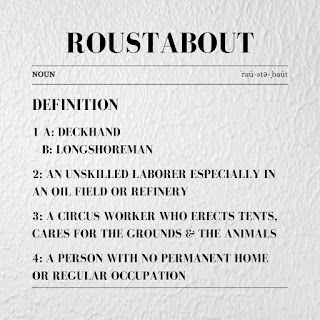
Roustabout SLIDE The only rung lower on the oil field hierarchy than being a roustabout was the unemployment line. If you couldn’t weld, then you would roughneck, If you couldn’t roughneck, then you’d service wells. If you couldn’t service wells, then you’d roustabout. If you couldn’t roustabout like Max and Ben, then you couldn’t find work at all.
So often, Max and Ben didn’t get hired because they lacked any of the hire level skills needed and Ben’s age didn’t help either. SLIDE off They often felt like they were a lost ball in the tall grass. A day late and a dollar short. One brick short of a load or one fry short of a happy meal. They felt worthless, like they would never get hired.


          There is a story in scripture that Jesus shares (a parable) that shows a similar situation with a very interesting outcome and shows how Jesus is ALL IN for us – even as he is about to face the cross. This is the first story Jesus tells at the beginning of his final week, and the last story he tells before entering Jerusalem. That means, the principle Jesus was teaching here was urgent and vital that his followers would understand. Before I share that parable story with you, here is what was written after the story was told…this is the perfect picture showing us that Jesus had jumped off the cliff and was all in – he had not yet hit the water but was on his way down…
Scripture SLIDE Matthew 20:17-19
Now as Jesus was going up to Jerusalem, he took the twelve disciples aside and said to them, "We are going up to Jerusalem, and the Son of Man will be betrayed to the chief priests and the teachers of the law. They will condemn him to death and will turn him over to the Gentiles to be mocked and flogged and crucified. On the third day he will be raised to life!"  End SLIDE
          Just before Jesus jumped all in for us on this day, he told the following story:
Matt 20:1-16
"For the kingdom of heaven is like a landowner who went out early in the morning to hire men to work in his vineyard. He agreed to pay them a denarius for the day and sent them into his vineyard.
"About the third hour he went out and saw others standing in the marketplace doing nothing. He told them, 'You also go and work in my vineyard, and I will pay you whatever is right.' So they went.
"He went out again about the sixth hour and the ninth hour and did the same thing. About the eleventh hour he went out and found still others standing around. He asked them, 'Why have you been standing here all day long doing nothing?'
"'Because no one has hired us,' they answered.
"He said to them, 'You also go and work in my vineyard.'
RETELL the story in my own words
"When evening came, the owner of the vineyard said to his foreman, 'Call the workers and pay them their wages, beginning with the last ones hired and going on to the first.'
"The workers who were hired about the eleventh hour came and each received a denarius. So when those came who were hired first, they expected to receive more. But each one of them also received a denarius. When they received it, they began to grumble against the landowner. 'These men who were hired last worked only one hour, and you have made them equal to us who have borne the burden of the work and the heat of the day.'
"But he answered one of them, 'Friend, I am not being unfair to you. Didn't you agree to work for a denarius? Take your pay and go. I want to give the man who was hired last the same as I gave you. Don't I have the right to do what I want with my own money? Or are you envious because I am generous?'
"So the last will be first, and the first will be last."
RETELL this part of story in my own words


CONCLUSION
          Remember Max and Ben, one day, about 5:00 a black pick up drove past them as they were the only two left in the roustabout camp – they had no where better to be. Then the truck stopped and backed up and told them to hop in that the boss needed them for some work to do.
          Who is still waiting around at 5:00 to find work? Who notices anyone that late still looking for work and who would hire anyone that late in the day?
 
          I wonder if Jesus was the one driving that pick up truck. Let’s consider two other scriptures that shine light on this one.
 
1)    The thief on the cross.
While Jesus hung on the cross ALL IN there were two roustabouts also hanging on crosses with him, one on either side. The roustabout on Jesus’ left complained that he had once again not been hired and left knowing he would not find work that day.
However, the roustabout to Jesus right decided to hang around just in case. No, he didn’t have high hopes of getting hired, but he knew that he could not work if he left. So, this one stayed right there and even asked Jesus to consider hiring him. What was the harm in asking. Isn’t that amazing, he did exactly what we roustabouts can do, talk directly to Jesus. There is no mediator between God and man except Jesus Christ. Without us realizing it, he is the boss, the one who has work to offer – or in this case the one who has forgiveness and eternal life to offer. At that moment Jesus backed up his pick up and told the thief on the cross to get in, that he had more for him to do and he would be doing it with him that day in paradise. The thief jumped into Christ’s pick up and was now also ALL IN with Jesus!


2)    Go in to the highways and byways and compel them to come in.
Luke 14:16-24
Jesus replied: "A certain man was preparing a great banquet and invited many guests. At the time of the banquet he sent his servant to tell those who had been invited, 'Come, for everything is now ready.' "But they all alike began to make excuses. The first said, 'I have just bought a field, and I must go and see it. Please excuse me.' "Another said, 'I have just bought five yoke of oxen, and I'm on my way to try them out. Please excuse me.'  "Still another said, 'I just got married, so I can't come.'
"The servant came back and reported this to his master. Then the owner of the house became angry and ordered his servant, 'Go out quickly into the streets and alleys of the town and bring in the poor, the crippled, the blind and the lame.'  "'Sir,' the servant said, 'what you ordered has been done, but there is still room.' "Then the master told his servant, 'Go out to the roads and country lanes and make them come in, so that my house will be full. I tell you, not one of those men who were invited will get a taste of my banquet.'"


Sunday, February 20, 2022

02-20-22 2022 Theme Introduction “ALL IN”

Scripture   Deuteronomy 6:4-5
Are you ready to dive “all in” to our 2022 church and preaching theme? The theme is “All in”
Someone diving is a perfect metaphor for being all in with Christ. Title slides


As you stand there getting ready – you may be terrified of the jump, or the water below, but you know, once you step or jump off the ledge – you are all in – there is no going back.
You can’t be mid-air and go, I changed my mind, I want to go back to the diving board or the cliff I just jumped from. Even before you hit the water, your commitment is already all in. That is a scary and beautiful thing. We even sometimes call it what? A leap of faith!
Then when you hit the water there is a new understand to being all in – you can’t dive and just go in half-way. Physics says your whole body is going to get wet and be immersed in the water. You have now gone ALL IN.
          (Example: Mormon Baptism when the girls hand did not go in they had to rebaptize her).
 
So, what does “All in” look like as far as a year for preaching? What will we hear – where will the emphasis lie?
Unlike red letter edition that was based solely on the words or Jesus, or HIStory that always had to contain a story of God working through his people, this theme can take us many places in many different ways: For instance---
1       All in can refer to how God was "All in".  When you think about God as a baby in a manger – God the Father was all in. When you think about Jesus taking 12 people to train so his church could be established after he was gone – the Spirit was all in. When you see Jesus on the cross dying for our sins – Jesus was all in. We can see throughout scripture and throughout church history how God was all in for our sakes and the sake of his church.
2       All in can refer to a person coming to faith - when you turn from the world to faith and Jesus, it cannot be in part but must be with all of your heart, soul, (mind) and strength. Once you leap – the water awaits – there is no turning back.
3       All in can refer to your commitment to Christ’s church - no longer settle for just attending, but making the health and growth of the church a priority in your life - being 'all in'. It means your commitment to loving others as Christ loved you will show itself in real tangible ways of service to others.


All in has examples throughout the OT and NT.
          David was all in against Goliath. Peter was all in when he stepped onto the water. The priests were all in when they stepped into the Jordan to cross on dry ground. Jacob was all in when he wrestled with God. Moses was all in when he went to Pharaoh, Stephen was all in when he stood up for Jesus, Paul was all in - always! A centurion was all in when he trusted his servant could be healed just by Jesus speaking a word.
There are examples of Christians “all in” throughout church history: Conrad Grebel, John Huss, Polycarp, Martin Luther, Adoniram Judson, Mother Teresa, etc.
 
          There are many scriptures we can turn to that speak of being all in, but our undergirding text is the single most significant text to the Jewish people and is called the SHEMA! To have any theme, it must be based on scripture, so today we are going to take a close look at the SHEMA.
The Shema is prayed twice daily (morning – rising, and evening when lying down) by Jews and (most of us are familiar with the beginning) but the whole Shema prayer consists of 3 separate texts all prayed at one time. They are Deuteronomy 6:4-9   /  Deuteronomy 11:13-21  /  Numbers15:37-41
Following the example of the scholar-martyr Rabbi Akiba (2nd century AD), the Shema has been uttered by Jewish martyrs throughout the ages as their final profession of faith in the one God of humankind and their love for him. Pious Jews hope to die with the words of the Shema on their lips. This text for Jews means they are all in – it should do no less for us who follow Christ.
THE SHEMA


Deuteronomy 6:4-9
Hear, O Israel: The Lord our God, the Lord is one.  5 Love the Lord your God with all your heart and with all your soul and with all your strength. 6 These commandments that I give you today are to be upon your hearts. 7 Impress them on your children. Talk about them when you sit at home and when you walk along the road, when you lie down and when you get up. 8 Tie them as symbols on your hands and bind them on your foreheads. 9 Write them on the doorframes of your houses and on your gates.
 
Deuteronomy 11:13-21
 So if you faithfully obey the commands I am giving you today — to love the Lord your God and to serve him with all your heart and with all your soul —  14 then I will send rain on your land in its season, both autumn and spring rains, so that you may gather in your grain, new wine and oil. 15 I will provide grass in the fields for your cattle, and you will eat and be satisfied. 16 Be careful, or you will be enticed to turn away and worship other gods and bow down to them. 17 Then the Lord's anger will burn against you, and he will shut the heavens so that it will not rain and the ground will yield no produce, and you will soon perish from the good land the Lord is giving you. 18 Fix these words of mine in your hearts and minds; tie them as symbols on your hands and bind them on your foreheads. 19 Teach them to your children, talking about them when you sit at home and when you walk along the road, when you lie down and when you get up. 20 Write them on the doorframes of your houses and on your gates, 21 so that your days and the days of your children may be many in the land that the Lord swore to give your forefathers, as many as the days that the heavens are above the earth.
 
 
Numbers15:37-41
The Lord said to Moses, 38 "Speak to the Israelites and say to them: 'Throughout the generations to come you are to make tassels on the corners of your garments, with a blue cord on each tassel. 39 You will have these tassels to look at and so you will remember all the commands of the Lord, that you may obey them and not prostitute yourselves by going after the lusts of your own hearts and eyes. 40 Then you will remember to obey all my commands and will be consecrated to your God. 41 I am the Lord your God, who brought you out of Egypt to be your God. I am the Lord your God.'"
 
         We will look at just the beginning part of the SHEMA. Deuteronomy 6:4-5. Being a prayer that everyone recognizes, the closest thing to that for Christians, would be the Lord’s prayer which we can’t even agree on all the wording (debts vs trespasses and do you include the extra-biblical part at the end).
The Shema gets its name from the first Hebrew word of the prayer in Deuteronomy 6:4   “Listen/Hear, Israel, the Lord is our God, the Lord is one.” SHEMA in Hebrew is translated “Listen” in English. But like so many words translated, our English word does not give the full meaning of Shema. This VIDEO will say it better than I can. So “Hear, Oh Ashland!”
Play Shema video
The Shema is attributed to Moses before the next generation of Israel entered the Promised Land. Moses challenges them with his wisdom and warning because he doesn’t want these Israelites to repeat their parents’ mistakes. Rather, he invites them to respond to God’s grace and mercy with love, faithfulness, and obedience.
 
Translating the Shema
Bible geeks, you will find this part really interesting. But be warned--it’s kind of complicated! From ancient times, there has been much debate on how exactly to translate and interpret the Shema, due to ambiguity in the grammar of the main sentences. There is no present-tense verb equivalent to the English verb “is” in Ancient Hebrew. There is a word for “was” (Heb. hayah) and “will be” (Heb. yihyeh), but “is” doesn’t exist. Rather, two words are put next to each other and the word “is” is inferred.
For example:     English: “The car is red.” Ancient Hebrew: “The car red.”
Ancient Israelites obviously had a concept of the verb “is,” they just didn’t use a word to express it in their language. The problem in translating and interpreting the Shema arises from the fact that it’s made of two back-to-back sentences that lack the word “is.” In Hebrew, the prayer consists of four nouns in a row.
Hebrew: YHWH ‘elohenu YHWH ekhad English: Lord our god Lord one
Depending on where you place the word “is,” you can end up with different sentences.
1.     The Lord our God is one Lord.
2.     The Lord is our God, the Lord is one.
3.     The Lord our God, the Lord is one.
The meaning between these options isn’t drastically different, but each one has a different emphasis. Is the point that the Lord God is one and not many (#1 or 3), or is the emphasis on the fact that only the Lord is our God (#2)? Does the Shema claim that Israel’s God is one being, or is it highlighting that the Lord alone is Israel’s God and not any other?
This last meaning seems to fit the overall context of Deuteronomy much better. In other words, the Shema isn’t trying to make a philosophical statement about God’s essence or being (that God is “one”). Rather, the Shema is a pledge of allegiance to the Lord God of Israel that excludes allegiance to any other gods. Remember Isa 46:9 “Remember the former things, those of long ago; I am God, and there is no other; I am God, and there is none like me.” That is clearly stating that God is one but the important here like in the Shema, it is calling for an allegiance to this one God!
Polytheistic Threat
Moses clearly believes that loyalty, obedience, and love to their one true God is the only way to life. One of the greatest threats to Israel’s future was dividing their allegiance between many gods. And so, the Shema is a daily reminder that “The Lord our God alone is our God.” The prayer goes on from here to show the value of passing this conviction on to later generations to spare them the tragic results of idolatry to other gods. (Like the B I B L E song: “I stand alone on the Word of God” NO – it is: “I stand on the Word of God alone”) Allegiance to the word of God only – The Shema – allegiance to YHWH ‘elohenu – the Lord our God!
“You shall teach them diligently to your children and shall talk of them when you sit in your house, and when you walk by the way, and when you lie down, and when you rise up.”
Shema Usage in the New Testament
The Shema became a twice-daily prayer within Judaism. It was so widely practiced in the second-temple period, Jesus himself grew up praying it. This prayer was formative for Jesus and he drew upon it in his teachings.
Mark 12:28-34
One of the teachers of the law came and heard them debating. Noticing that Jesus had given them a good answer, he asked him, "Of all the commandments, which is the most important?" "The most important one," answered Jesus, "is this: 'Hear, O Israel, the Lord our God, the Lord is one.  Love the Lord your God with all your heart and with all your soul and with all your mind and with all your strength.'  The second is this: 'Love your neighbor as yourself.' There is no commandment greater than these." "Well said, teacher," the man replied. "You are right in saying that God is one and there is no other but him. To love him with all your heart, with all your understanding and with all your strength, and to love your neighbor as yourself is more important than all burnt offerings and sacrifices." When Jesus saw that he had answered wisely, he said to him, "You are not far from the kingdom of God."
In other words, this teacher of the law understood the word of God so well, particularly the SHEMA, even with Jesus adding the second greatest commandment to it, that Jesus was saying, you are standing on the edge of the cliff – you clearly see the water below, you are so close but not yet ALL IN. You need to jump, by faith, into the Living Water who is Jesus!


Picnic with the pastor
(Like the B I B L E song: “I stand alone on the Word of God” or it should be “I stand on the Word of God alone”)
The B I B L E, yes that’s the book for me, I stand alone on the word of God, the B I B L E. Bible!
That is wrong, we don’t stand all alone on the word of God, other people stand with us. When we say stand, we don’t mean to literally stand on the bible – it means we believe what it says and live by what it says. Like – “I stand on the fact that my moth loves me” It means you know it is true. We know the bible is true so we say we stand on it. But we don’t stand on it alone. Many stand with us.
How can we say what the person probably meant when they wrote this song?
The B I B L E, yes that’s the book for me, I stand on the word of God alone, the B I B L E. Bible!
That means we don’t listen to what the world says, we don’t have any other writings that are equal to the bible. We believe in (stand on) the word of God (the Bible) and nothing else. We stand on the word of God alone.